
Harris reiterates US ‘unwavering’ commitment to PH
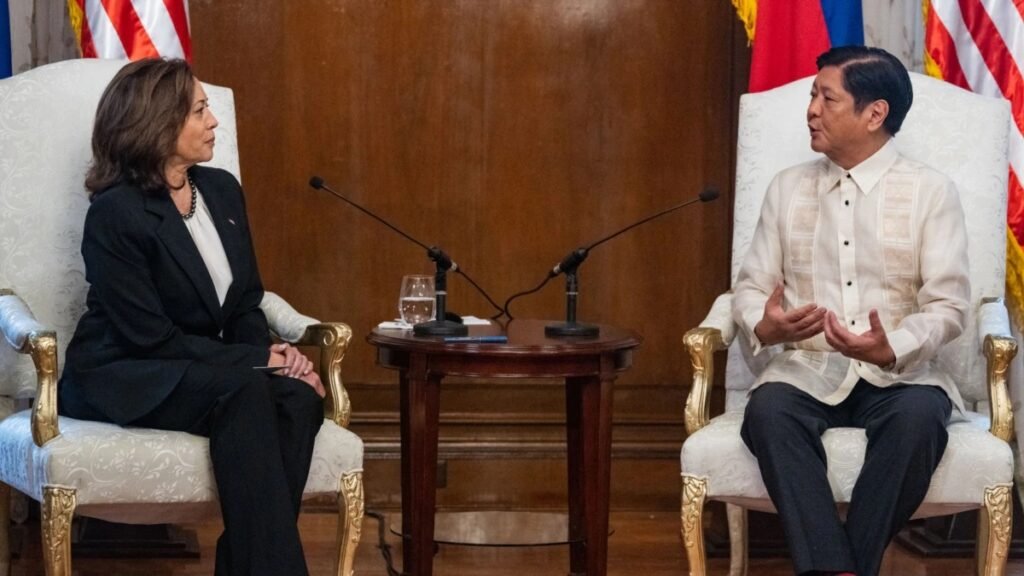
Vice President Kamala Harris has reaffirmed the United States’ “unwavering” commitment to the Philippines during a visit aimed at repairing relations that soured during the Duterte years, and countering China’s expanding influence in the region.
Since President Ferdinand Marcos assumed office in June, Harris is the highest-ranking US diplomat to travel to Manila. She landed in Manila as the Philippine military reported that a Chinese coastguard ship had “forcefully removed” in the South China Sea on Sunday a floating object being pulled by a Philippine vessel by severing the line holding it to the boat.
“We stand with you in defence of international rules and norms as it relates to the South China Sea,” Harris told Marcos at the start of talks in the presidential palace in Manila.
“An attack on the Philippine armed forces, public vessels or aircraft in the South China Sea would invoke the US mutual defence commitment … that is our unwavering commitment to the Philippines.”
A number of Southeast Asian countries, including the Philippines, have claims to the South China Sea.
Beijing, which controls the waterway nearly entirely, has been more assertive in recent years, building military stations and artificial islands.
During her three-day trip to the Philippines, Harris is scheduled to visit Palawan, an island at the edge of the South China Sea. She will also reiterate Washington’s support for a 2016 international tribunal decision that rejected China’s wide claim to the waters, a senior US official said. Beijing has rejected the judgment.
The US and the Marcos family have had a protracted and complicated relationship. Washington, which regarded his father as a friend in the Cold War, supported him while he ruled the former US colony for 20 years.
But once Duterte took office, ties between the two nations deteriorated. In 2016, after being warned that Barack Obama, the then-US president, would confront him about his contentious drug war, which has resulted in thousands of deaths, Duterte referred to Obama as the “son of a whore.”
Under his successor, Washington is currently looking to strengthen its security partnership with Manila.
According to Marcos, he does not “see a future for the Philippines that does not include the United States.”
Included in this are the 2014 EDCA deal and the Mutual Defense Treaty, both of which permit the US military to stockpile defense supplies and equipment on five Philippine military facilities and to rotate US soldiers through them.
As China becomes more forceful, the US and the Philippines have stated their support for hastening the implementation of EDCA.
The object was spotted floating in the South China Sea early on Sunday, some 730 meters (800 yards) west of Thitu Island, according to Vice Admiral Alberto Carlos, commander of the Western Command (WESCOM), who said Philippine officials had deployed a vessel to investigate the sighting.
Without going into detail about the object or why China might have taken it, the statement claimed that the team had tied the object to their boat and had begun to tow it when a Chinese coastguard vessel approached, twice blocked their path, and then sent out an inflatable boat to cut the tow line and take the object back to the coastguard ship.
An inquiry for comment was not immediately answered by the Chinese embassy in the Philippines.
The manmade island of Thitu, also called Pagasa by Filipinos, is adjacent to Subi Reef, one of the seven Spratly Islands where China has placed surface-to-air missiles and other armaments.
The Philippines has nine features in the Spratly archipelago, but Thitu is the most strategically significant outpost for the Southeast Asian nation in the South China Sea.
In a statement, the Philippine foreign ministry stated that it will investigate the event thoroughly and was awaiting comprehensive information from maritime law enforcement organizations.


